Pages

The Deputies of Santa Claus


However, there was one evil following in the path of civilization that caused Santa Claus a vast amount of trouble before he discovered a way to overcome it. But, fortunately, it was the last trial he was forced to undergo.

One Christmas Eve, when his reindeer had leaped to the top of a new building, Santa Claus was surprised to find that the chimney had been built much smaller than usual. But he had no time to think about it just then, so he drew in his breath and made himself as small as possible and slid down the chimney.

"I ought to be at the bottom by this time," he thought, as he continued to slip downward; but no fireplace of any sort met his view, and by and by he reached the very end of the chimney, which was in the cellar.

"This is odd!" he reflected, much puzzled by this experience. "If there is no fireplace, what on earth is the chimney good for?"

Then he began to climb out again, and found it hard work—the space being so small. And on his way up he noticed a thin, round pipe sticking through the side of the chimney, but could not guess what it was for.

Finally he reached the roof and said to the reindeer:

"There was no need of my going down that chimney, for I could find no fireplace through which to enter the house. I fear the children who live there must go without playthings this Christmas."

Then he drove on, but soon came to another new house with a small chimney. This caused Santa Claus to shake his head doubtfully, but he tried the chimney, nevertheless, and found it exactly like the other. Moreover, he nearly stuck fast in the narrow flue and tore his jacket trying to get out again; so, although he came to several such chimneys that night, he did not venture to descend any more of them.

"What in the world are people thinking of, to build such useless chimneys?" he exclaimed. "In all the years I have traveled with my reindeer I have never seen the like before."

True enough; but Santa Claus had not then discovered that stoves had been invented and were fast coming into use. When he did find it out he wondered how the builders of those houses could have so little consideration for him, when they knew very well it was his custom to climb down chimneys and enter houses by way of the fireplaces. Perhaps the men who built those houses had outgrown their own love for toys, and were indifferent whether Santa Claus called on their children or not. Whatever the explanation might be, the poor children were forced to bear the burden of grief and disappointment.

The following year Santa Claus found more and more of the new-fashioned chimneys that had no fireplaces, and the next year still more. The third year, so numerous had the narrow chimneys become, he even had a few toys left in his sledge that he was unable to give away, because he could not get to the children.
The First Journey with the Reindeer


Those were happy days for Claus when he carried his accumulation of toys to the children who had awaited them so long. During his imprisonment in the Valley he had been so industrious that all his shelves were filled with playthings, and after quickly supplying the little ones living near by he saw he must now extend his travels to wider fields.

Remembering the time when he had journeyed with Ak through all the world, he know children were everywhere, and he longed to make as many as possible happy with his gifts.

So he loaded a great sack with all kinds of toys, slung it upon his back that he might carry it more easily, and started off on a longer trip than he had yet undertaken.

Wherever he showed his merry face, in hamlet or in farmhouse, he received a cordial welcome, for his fame had spread into far lands. At each village the children swarmed about him, following his footsteps wherever he went; and the women thanked him gratefully for the joy he brought their little ones; and the men looked upon him curiously that he should devote his time to such a queer occupation as toy-making. But every one smiled on him and gave him kindly words, and Claus felt amply repaid for his long journey.

When the sack was empty he went back again to the Laughing Valley and once more filled it to the brim. This time he followed another road, into a different part of the country, and carried happiness to many children who never before had owned a toy or guessed that such a delightful plaything existed.

After a third journey, so far away that Claus was many days walking the distance, the store of toys became exhausted and without delay he set about making a fresh supply.

From seeing so many children and studying their tastes he had acquired several new ideas about toys.

The dollies were, he had found, the most delightful of all playthings for babies and little girls, and often those who could not say "dolly" would call for a "doll" in their sweet baby talk. So Claus resolved to make many dolls, of all sizes, and to dress them in bright-colored clothing. The older boys—and even some of the girls—loved the images of animals, so he still made cats and elephants and horses. And many of the little fellows had musical natures, and longed for drums and cymbals and whistles and horns. So he made a number of toy drums, with tiny sticks to beat them with; and he made whistles from the willow trees, and horns from the bog-reeds, and cymbals from bits of beaten metal.

All this kept him busily at work, and before he realized it the winter season came, with deeper snows than usual, and he knew he could not leave the Valley with his heavy pack. Moreover, the next trip would take him farther from home than every before, and Jack Frost was mischievous enough to nip his nose and ears if he undertook the long journey while the Frost King reigned. The Frost King was Jack's father and never reproved him for his pranks.

So Claus remained at his work-bench; but he whistled and sang as merrily as ever, for he would allow no disappointment to sour his temper or make him unhappy.
How Claus Made the First Toy

Truly our Claus had wisdom, for his good fortune but strengthened his resolve to befriend the little ones of his own race. He knew his plan was approved by the immortals, else they would not have favored him so greatly.
So he began at once to make acquaintance with mankind. He walked through the Valley to the plain beyond, and crossed the plain in many directions to reach the abodes of men. These stood singly or in groups of dwellings called villages, and in nearly all the houses, whether big or little, Claus found children.
The youngsters soon came to know his merry, laughing face and the kind glance of his bright eyes; and the parents, while they regarded the young man with some scorn for loving children more than their elders, were content that the girls and boys had found a playfellow who seemed willing to amuse them.
So the children romped and played games with Claus, and the boys rode upon his shoulders, and the girls nestled in his strong arms, and the babies clung fondly to his knees. Wherever the young man chanced to be, the sound of childish laughter followed him; and to understand this better you must know that children were much neglected in those days and received little attention from their parents, so that it became to them a marvel that so goodly a man as Claus devoted his time to making them happy. And those who knew him were, you may be sure, very happy indeed. The sad faces of the poor and abused grew bright for once; the cripple smiled despite his misfortune; the ailing ones hushed their moans and the grieved ones their cries when their merry friend came nigh to comfort them.
Only at the beautiful palace of the Lord of Lerd and at the frowning castle of the Baron Braun was Claus refused admittance. There were children at both places; but the servants at the palace shut the door in the young stranger's face, and the fierce Baron threatened to hang him from an iron hook on the castle walls. Whereupon Claus sighed and went back to the poorer dwellings where he was welcome.
After a time the winter drew near.
The flowers lived out their lives and faded and disappeared; the beetles burrowed far into the warm earth; the butterflies deserted the meadows; and the voice of the brook grew hoarse, as if it had taken cold.
One day snowflakes filled all the air in the Laughing Valley, dancing boisterously toward the earth and clothing in pure white raiment the roof of Claus's dwelling.
heavenly christmas tree
I am a novelist, and I suppose I have made up this story. I write "I suppose," though I know for a fact that I have made it up, but yet I keep fancying that it must have happened somewhere at some time, that it must have happened on Christmas Eve in some great town in a time of terrible frost.
I have a vision of a boy, a little boy, six years old or even younger. This boy woke up that morning in a cold damp cellar. He was dressed in a sort of little dressing-gown and was shivering with cold. There was a cloud of white steam from his breath, and sitting on a box in the corner, he blew the steam out of his mouth and amused himself in his dullness watching it float away. But he was terribly hungry. Several times that morning he went up to the plank bed where his sick mother was lying on a mattress as thin as a pancake, with some sort of bundle under her head for a pillow. How had she come here? She must have come with her boy from some other town and suddenly fallen ill. The landlady who let the "corners" had been taken two days before to the police station, the lodgers were out and about as the holiday was so near, and the only one left had been lying for the last twenty-four hours dead drunk, not having waited for Christmas. In another corner of the room a wretched old woman of eighty, who had once been a children's nurse but was now left to die friendless, was moaning and groaning with rheumatism, scolding and grumbling at the boy so that he was afraid to go near her corner. He had got a drink of water in the outer room, but could not find a crust anywhere, and had been on the point of waking his mother a dozen times. He felt frightened at last in the darkness: it had long[152] been dusk, but no light was kindled. Touching his mother's face, he was surprised that she did not move at all, and that she was as cold as the wall. "It is very cold here," he thought. He stood a little, unconsciously letting his hands rest on the dead woman's shoulders, then he breathed on his fingers to warm them, and then quietly fumbling for his cap on the bed, he went out of the cellar. He would have gone earlier, but was afraid of the big dog which had been howling all day at the neighbour's door at the top of the stairs. But the dog was not there now, and he went out into the street.
Mercy on us, what a town! He had never seen anything like it before. In the town from which he had come, it was always such black darkness at night. There was one lamp for the whole street, the little, low-pitched, wooden houses were closed up with shutters, there was no one to be seen in the street after dusk, all the people shut themselves up in their houses, and there was nothing but the howling of packs of dogs, hundreds and thousands of them barking and howling all night. But there it was so warm and he was given food, while here—oh, dear, if he only had something to eat! And what a noise and rattle here, what light and what people, horses and carriages, and what a frost! The frozen steam hung in clouds over the horses, over their warmly breathing mouths; their hoofs clanged against the stones through the powdery snow, and every one pushed so, and—oh, dear, how he longed for some morsel to eat, and how wretched he suddenly felt. A policeman walked by and turned away to avoid seeing the boy.
Here was another street—oh, what a wide one, here he would be run over for certain; how everyone was shouting, racing and driving along, and the light, the light! And what was this? A huge glass window, and through the window a tree reaching up to the ceiling; it was a fir tree, and on it were ever so many lights, gold papers and apples and little dolls and horses; and there were children clean and dressed[153] in their best running about the room, laughing and playing and eating and drinking something. And then a little girl began dancing with one of the boys, what a pretty little girl! And he could hear the music through the window. The boy looked and wondered and laughed, though his toes were aching with the cold and his fingers were red and stiff so that it hurt him to move them. And all at once the boy remembered how his toes and fingers hurt him, and began crying, and ran on; and again through another window-pane he saw another Christmas tree, and on a table cakes of all sorts—almond cakes, red cakes and yellow cakes, and three grand young ladies were sitting there, and they gave the cakes to any one who went up to them, and the door kept opening, lots of gentlemen and ladies went in from the street. The boy crept up, suddenly opened the door and went in. Oh, how they shouted at him and waved him back! One lady went up to him hurriedly and slipped a kopeck into his hand, and with her own hands opened the door into the street for him! How frightened he was. And the kopeck rolled away and clinked upon the steps; he could not bend his red fingers to hold it tight. The boy ran away and went on, where he did not know. He was ready to cry again but he was afraid, and ran on and on and blew his fingers. And he was miserable because he felt suddenly so lonely and terrified, and all at once, mercy on us! What was this again? People were standing in a crowd admiring. Behind a glass window there were three little dolls, dressed in red and green dresses, and exactly, exactly as though they were alive. One was a little old man sitting and playing a big violin, the two others were standing close by and playing little violins and nodding in time, and looking at one another, and their lips moved, they were speaking, actually speaking, only one couldn't hear through the glass. And at first the boy thought they were alive, and when he grasped that they were dolls he laughed. He had never seen such dolls before, and had no idea there were such[154] dolls! And he wanted to cry, but he felt amused, amused by the dolls. All at once he fancied that some one caught at his smock behind: a wicked big boy was standing beside him and suddenly hit him on the head, snatched off his cap and tripped him up. The boy fell down on the ground, at once there was a shout, he was numb with fright, he jumped up and ran away. He ran, and not knowing where he was going, ran in at the gate of some one's courtyard, and sat down behind a stack of wood: "They won't find me here, besides it's dark!"
He sat huddled up and was breathless from fright, and all at once, quite suddenly, he felt so happy: his hands and feet suddenly left off aching and grew so warm, as warm as though he were on a stove; then he shivered all over, then he gave a start, why, he must have been asleep. How nice to have a sleep here! "I'll sit here a little and go and look at the dolls again," said the boy, and smiled thinking of them. "Just as though they were alive!..." And suddenly he heard his mother singing over him. "Mammy, I am asleep; how nice it is to sleep here!"
"Come to my Christmas tree, little one," a soft voice suddenly whispered over his head.
He thought that this was still his mother, but no, it was not she. Who it was calling him, he could not see, but some one bent over and embraced him in the darkness; and he stretched out his hands to him, and ... and all at once—oh, what a bright light! Oh, what a Christmas tree! And yet it was not a fir tree, he had never seen a tree like that! Where was he now? Everything was bright and shining, and all round him were dolls; but no, they were not dolls, they were little boys and girls, only so bright and shining. They all came flying round him, they all kissed him, took him and carried him along with them, and he was flying himself, and he saw that his mother was looking at him and laughing joyfully. "Mammy, Mammy; oh, how nice it is here, Mammy!" And again he kissed the children and wanted to tell them at[155] once of those dolls in the shop window. "Who are you, boys? Who are you, girls?" he asked, laughing and admiring them.
"This is Christ's Christmas tree," they answered. "Christ always has a Christmas tree on this day, for the little children who have no tree of their own...." And he found out that all these little boys and girls were children just like himself; that some had been frozen in the baskets in which they had as babies been laid on the doorsteps of well-to-do Petersburg people, others had been boarded out with Finnish women by the Foundling and had been suffocated, others had died at their starved mother's breasts (in the Samara famine), others had died in the third-class railway carriages from the foul air; and yet they were all here, they were all like angels about Christ, and He was in the midst of them and held out His hands to them and blessed them and their sinful mothers.... And the mothers of these children stood on one side weeping; each one knew her boy or girl, and the children flew up to them and kissed them and wiped away their tears with their little hands, and begged them not to weep because they were so happy.
And down below in the morning the porter found the little dead body of the frozen child on the woodstack; they sought out his mother too.... She had died before him. They met before the Lord God in heaven.
Why have I made up such a story, so out of keeping with an ordinary diary, and a writer's above all? And I promised two stories dealing with real events! But that is just it, I keep fancying that all this may have happened really—that is, what took place in the cellar and on the woodstack; but as for Christ's Christmas tree, I cannot tell you whether that could have happened or not.
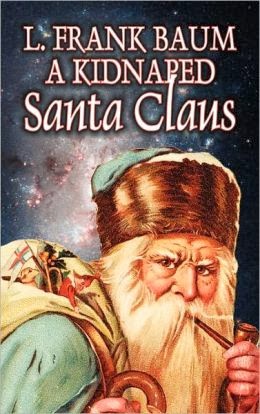
kidnaped sata claus

 by L. Frank Baum

Santa Claus lives in the Laughing Valley, where stands the big, rambling castle in which his toys are manufactured. His workmen, selected from the ryls, knooks, pixies and fairies, live with him, and every one is as busy as can be from one year's end to another.

It is called the Laughing Valley because everything there is happy and gay. The brook chuckles to itself as it leaps rollicking between its green banks; the wind whistles merrily in the trees; the sunbeams dance lightly over the soft grass, and the violets and wild flowers look smilingly up from their green nests. To laugh one needs to be happy; to be happy one needs to be content. And throughout the Laughing Valley of Santa Claus contentment reigns supreme.

On one side is the mighty Forest of Burzee. At the other side stands the huge mountain that contains the Caves of the Daemons. And between them the Valley lies smiling and peaceful.

One would think that our good old Santa Claus, who devotes his days to making children happy, would have no enemies on all the earth; and, as a matter of fact, for a long period of time he encountered nothing but love wherever he might go.

But the Daemons who live in the mountain caves grew to hate Santa Claus very much, and all for the simple reason that he made children happy.

The Caves of the Daemons are five in number. A broad pathway leads up to the first cave, which is a finely arched cavern at the foot of the mountain, the entrance being beautifully carved and decorated. In it resides the Daemon of Selfishness. Back of this is another cavern inhabited by the Daemon of Envy. The cave of the Daemon of Hatred is next in order, and through this one passes to the home of the Daemon of Malice--situated in a dark and fearful cave in the very heart of the mountain. I do not know what lies beyond this. Some say there are terrible pitfalls leading to death and destruction, and this may very well be true. However, from each one of the four caves mentioned there is a small, narrow tunnel leading to the fifth cave--a cozy little room occupied by the Daemon of Repentance. And as the rocky floors of these passages are well worn by the track of passing feet, I judge that many wanderers in the Caves of the Daemons have escaped through the tunnels to the abode of the Daemon of Repentance, who is said to be a pleasant sort of fellow who gladly opens for one a little door admitting you into fresh air and sunshine again.

Well, these Daemons of the Caves, thinking they had great cause to dislike old Santa Claus, held a meeting one day to discuss the matter.

"I'm really getting lonesome," said the Daemon of Selfishness. "For Santa Claus distributes so many pretty Christmas gifts to all the children that they become happy and generous, through his example, and keep away from my cave."

"I'm having the same trouble," rejoined the Daemon of Envy. "The little ones seem quite content with Santa Claus, and there are few, indeed, that I can coax to become envious."

Papa Panov
It was Christmas Eve and although it was still afternoon, lights had begun to appear in the shops and houses of the little Russian village, for the short winter day was nearly over. Excited children scurried indoors and now only muffled sounds of chatter and laughter escaped from closed shutters.

Old Papa Panov, the village shoemaker, stepped outside his shop to take one last look around. The sounds of happiness, the bright lights and the faint but delicious smells of Christmas cooking reminded him of past Christmas times when his wife had still been alive and his own children little. Now they had gone. His usually cheerful face, with the little laughter wrinkles behind the round steel spectacles, looked sad now. But he went back indoors with a firm step, put up the shutters and set a pot of coffee to heat on the charcoal stove. Then, with a sigh, he settled in his big armchair.

Papa Panov did not often read, but tonight he pulled down the big old family Bible and, slowly tracing the lines with one forefinger, he read again the Christmas story. He read how Mary and Joseph, tired by their journey to Bethlehem, found no room for them at the inn, so that Mary's little baby was born in the cowshed.

"Oh, dear, oh, dear!" exclaimed Papa Panov, "if only they had come here! I would have given them my bed and I could have covered the baby with my patchwork quilt to keep him warm."

He read on about the wise men who had come to see the baby Jesus, bringing him splendid gifts. Papa Panov's face fell. "I have no gift that I could give him," he thought sadly.

Then his face brightened. He put down the Bible, got up and stretched his long arms t the shelf high up in his little room. He took down a small, dusty box and opened it. Inside was a perfect pair of tiny leather shoes. Papa Panov smiled with satisfaction. Yes, they were as good as he had remembered- the best shoes he had ever made. "I should give him those," he decided, as he gently put them away and sat down again.

He was feeling tired now, and the further he read the sleeper he became. The print began to dance before his eyes so that he closed them, just for a minute. In no time at all Papa Panov was fast asleep.
Claus Leaves the Forest


When good Queen Zurline had touched the golden chalice with her fair lips and it had passed around the circle in honor of the travelers' return, the Master Woodsman of the World, who had not yet spoken, turned his gaze frankly upon Claus and said:

"Well?"

The boy understood, and rose slowly to his feet beside Necile. Once only his eyes passed around the familiar circle of nymphs, every one of whom he remembered as a loving comrade; but tears came unbidden to dim his sight, so he gazed thereafter steadfastly at the Master.

"I have been ignorant," said he, simply, "until the great Ak in his kindness taught me who and what I am. You, who live so sweetly in your forest bowers, ever fair and youthful and innocent, are no fit comrades for a son of humanity. For I have looked upon man, finding him doomed to live for a brief space upon earth, to toil for the things he needs, to fade into old age, and then to pass away as the leaves in autumn. Yet every man has his mission, which is to leave the world better, in some way, than he found it. I am of the race of men, and man's lot is my lot. For your tender care of the poor, forsaken babe you adopted, as well as for your loving comradeship during my boyhood, my heart will ever overflow with gratitude. My foster-mother," here he stopped and kissed Necile's white forehead, "I shall love and cherish while life lasts. But I must leave you, to take my part in the endless struggle to which humanity is doomed, and to live my life in my own way."

"What will you do?" asked the Queen, gravely.

"I must devote myself to the care of the children of mankind, and try to make them happy," he answered. "Since your own tender care of a babe brought to me happiness and strength, it is just and right that I devote my life to the pleasure of other babes. Thus will the memory of the loving nymph Necile be planted within the hearts of thousands of my race for many years to come, and her kindly act be recounted in song and in story while the world shall last. Have I spoken well, O Master?"

wooden shoes

Once upon a time--so long ago that everybody has forgotten the date--in a city in the north of Europe--with such a hard name that nobody can ever remember it--there was a little seven-year-old boy named Wolff, whose parents were dead, who lived with a cross and stingy old aunt, who never thought of kissing him more than once a year and who sighed deeply whenever she gave him a bowlful of soup.
But the poor little fellow had such a sweet nature that in spite of everything, he loved the old woman, although he was terribly afraid of her and could never look at her ugly old face without shivering.
As this aunt of little Wolff was known to have a house of her own and an old woollen stocking full of gold, she had not dared to send the boy to a charity school; but, in order to get a reduction in the price, she had so wrangled with the master of the school, to which little Wolff finally went, that this bad man, vexed at having a pupil so poorly dressed and paying so little, often punished him unjustly, and even prejudiced his companions against him, so that the three boys, all sons of rich parents, made a drudge and laughing stock of the little fellow.
The poor little one was thus as wretched as a child could be and used to hide himself in corners to weep whenever Christmas time came.
It was the schoolmaster's custom to take all his pupils to the midnight mass on Christmas Eve, and to bring them home again afterward.
Now, as the winter this year was very bitter, and as heavy snow had been falling for several days, all the boys came well bundled up in warm clothes, with fur caps pulled over their ears, padded jackets, gloves and knitted mittens, and strong, thick-soled boots. Only little Wolff presented himself shivering in the poor clothes he used to wear both weekdays and Sundays and having on his feet only thin socks in heavy wooden shoes.
His naughty companions noticing his sad face and awkward appearance, made many jokes at his expense; but the little fellow was so busy blowing on his fingers, and was suffering so much with chilblains, that he took no notice of them. So the band of youngsters, walking two and two behind the master, started for the church.
It was pleasant in the church which was brilliant with lighted candles; and the boys excited by the warmth took advantage of the music of the choir and the organ to chatter among themselves in low tones. They bragged about the fun that was awaiting them at home. The mayor's son had seen, just before starting off, an immense goose ready stuffed and dressed for cooking. At the alderman's home there was a little pine-tree with branches laden down with oranges, sweets, and toys. And the lawyer's cook had put on her cap with such care as she never thought of taking unless she was expecting something very good!
Then they talked, too, of all that the Christ-Child was going to bring them, of all he was going to put in their shoes which, you might be sure, they would take good care to leave in the chimney place before going to bed; and the eyes of these little urchins, as lively as a cage of mice, were sparkling in advance over the joy they would have when they awoke in the morning and saw the pink bag full of sugar-plums, the little lead soldiers ranged in companies in their boxes, the menageries smelling of varnished wood, and the magnificent jumping-jacks in purple and tinsel.
Alas! Little Wolff knew by experience that his old miser of an aunt would send him to bed supperless, but, with childlike faith and certain of having been, all the year, as good and industrious as possible, he hoped that the Christ-Child would not forget him, and so he, too, planned to place his wooden shoes in good time in the fireplace.
Midnight mass over, the worshippers departed, eager for their fun, and the band of pupils always walking two and two, and following the teacher, left the church.
Now, in the porch and seated on a stone bench set in the niche of a painted arch, a child was sleeping--a child in a white woollen garment, but with his little feet bare, in spite of the cold. He was not a beggar, for his garment was white and new, and near him on the floor was a bundle of carpenter's tools.
In the clear light of the stars, his face, with its closed eyes, shone with an expression of divine sweetness, and his long, curling, blond locks seemed to form a halo about his brow. But his little child's feet, made blue by the cold of this bitter December night, were pitiful to see!
The boys so well clothed for the winter weather passed by quite indifferent to the unknown child; several of them, sons of the notables of the town, however, cast on the vagabond looks in which could be read all the scorn of the rich for the poor, of the well-fed for the hungry.
But little Wolff, coming last out of the church, stopped, deeply touched, before the beautiful sleeping child.
"Oh, dear!" said the little fellow to himself, "this is frightful! This poor little one has no shoes and stockings in this bad weather--and, what is still worse, he has not even a wooden shoe to leave near him to-night while he sleeps, into which the little Christ-Child can put something good to soothe his misery."
And carried away by his loving heart, Wolff drew the wooden shoe from his right foot, laid it down before the sleeping child, and, as best he could, sometimes hopping, sometimes limping with his sock wet by the snow, he went home to his aunt.
"Look at the good-for-nothing!" cried the old woman, full of wrath at the sight of the shoeless boy. "What have you done with your shoe, you little villain?"
Little Wolff did not know how to lie, so, although trembling with terror when he saw the rage of the old shrew, he tried to relate his adventure.
But the miserly old creature only burst into a frightful fit of laughter.
"Aha! So my young gentleman strips himself for the beggars. Aha! My young gentleman breaks his pair of shoes for a bare-foot! Here is something new, forsooth. Very well, since it is this way, I shall put the only shoe that is left into the chimney-place, and I'll answer for it that the Christ-Child will put in something to-night to beat you with in the morning! And you will have only a crust of bread and water to-morrow. And we shall see if the next time, you will be giving your shoes to the first vagabond that happens along."
And the wicked woman having boxed the ears of the poor little fellow, made him climb up into the loft where he had his wretched cubbyhole.
Desolate, the child went to bed in the dark and soon fell asleep, but his pillow was wet with tears.
But behold! the next morning when the old woman, awakened early by the cold, went downstairs--oh, wonder of wonders--she saw the big chimney filled with shining toys, bags of magnificent bonbons, and riches of every sort, and standing out in front of all this treasure, was the right wooden shoe which the boy had given to the little vagabond, yes, and beside it, the one which she had placed in the chimney to hold the bunch of switches.
As little Wolff, attracted by the cries of his aunt, stood in an ecstasy of childish delight before the splendid Christmas gifts, shouts of laughter were heard outside. The woman and child ran out to see what all this meant, and behold! all the gossips of the town were standing around the public fountain. What could have happened? Oh, a most ridiculous and extraordinary thing! The children of the richest men in the town, whom their parents had planned to surprise with the most beautiful presents had found only switches in their shoes!
Then the old woman and the child thinking of all the riches in their chimney were filled with fear. But suddenly they saw the priest appear, his countenance full of astonishment. Just above the bench placed near the door of the church, in the very spot where, the night before, a child in a white garment and with bare feet, in spite of the cold, had rested his lovely head, the priest had found a circlet of gold imbedded in the old stones.
Then, they all crossed themselves devoutly, perceiving that this beautiful sleeping child with the carpenter's tools had been Jesus of Nazareth himself, who had come back for one hour just as he had been when he used to work in the home of his parents; and reverently they bowed before this miracle, which the good God had done to reward the faith and the love of a little child.
IT was Christmas Day, and the Cratchit family were going to have a most wonderful dinner. Perhaps, some other days, they had scarcely enough to eat, for they were a large family. Work as hard as Father Bob Cratchit could, there was often not enough to go around. For there were Mother Cratchit, and Martha who worked in the milliner's shop, and Belinda who helped at home, and Peter, and the two little Cratch- its, and, last of all, Tiny Tim. Alas for Tiny Tim! He bore always a little crutch and had his limbs supported by an iron frame! But, although he was only a little, little child, Tiny Tim was patient and mild, and they loved him more than all the rest. And it was Christmas Day.

Mother Cratchit and Belinda laid the cloth, and Peter blew the fire until the slow potatoes, bubbling up, knocked loudly at the saucepan lid to be let out and peeled. The two little Cratchits came tearing in to say that outside, at the baker's, they had smelled a goose and knew it for their very own. Martha came home, and, last of all, in came little Bob, the father, wrapped up in three feet of muffler, with his thread-bare clothes darned and brushed to look seasonable, and with Tiny Tim on his shoulder.

"And how did little Tim behave?" asked Mother Cratchit.

"As good as gold," said Bob, "and better," setting Tiny Tim carefully down, while the two little Cratchits hustled him off to the wash-house, that he might hear the pudding singing in the copper.

"He told me coming home that he hoped the people saw him in the church, because he was a cripple, and it might be pleasant for them to remember, upon Christmas Day, Who made lame beggars to walk and blind men to see."

Bob's voice trembled, and it trembled more as he said that he thought Tiny Tim was growing very strong and well.

But they heard the sound of Tiny Tim's little crutch upon the floor and they helped him over to his stool by the fire—while the two little Cratchits went out to the baker's to fetch the goose. Mother Cratchit made the gravy (ready before in a little saucepan) hissing hot; Peter mashed the potatoes; Belinda sweetened the apple sauce; Martha dusted the hot plates; Bob took Tiny Tim beside him in a tiny corner at the table; and the two little Cratchits (come home with the goose) set chairs for everybody, cramming spoons in their mouths lest they should shriek for goose before it came their turn to be served.

There never was such a goose! Bob said he didn't believe there ever was such a goose cooked. With the apple sauce and the mashed potatoes there was sufficient dinner for the whole family. Indeed, Mother Cratchit said, as she looked at one small atom of a bone upon the dish: "They hadn't eaten it all, at last." The little Cratchits were steeped in sage and onions to the eyebrows. But presently Belinda changed the plates and Mother Cratchit left the room—alone—to take up the pudding and bring it in!

Suppose it should not be done. Suppose it should break. Suppose some one had come over the back wall and stolen it while they were making merry with the goose. Hello! a great deal of steam. The pudding was out of the copper. A smell like a washing-day! That was the cloth. A smell like an eating-house and a pastry cook's next door to each other, with a laundress's next door to that! That was the pudding.

In half a minute Mother Cratchit entered with the pudding like a speckled cannon-ball, so hard and firm, and blazing, and bedight with Christmas holly stuck into the top! Everybody had something to say about it, but nobody thought it at all a small pudding for a large family. Any Cratchit would have blushed to hint at such a thing.

At last the dinner was all done, the cloth was cleared, the hearth swept and the fire made up. A whole pile of apples and oranges was put upon the table; and a shovelful of chestnuts upon the fire, beginning at once to sputter and crackle noisily. Then all the Cratchit family drew around the hearth, and Tiny Tim sat very close to his father's side upon his little stool. Bob held his withered little hand in his, for he loved the child, and he said:

"A merry Christmas to us all, my dears; God bless us!"

"Merry Christmas! Merry Christmas!" said all the Cratchit family.

And: "God bless us—every one!" said Tiny Tim, the last of all.


C. S. B. Adapted from Charles Dickens' "Christmas Carol."
It was long past midnight and the Stocking was angry.

"To be taken out of a nice comfortable drawer on a winter night", it said querulously, "and, without being hung in front of the kitchen fire, to be strung up to a bedpost like a common thing. Upon my word, it is too bad!"

A little girl lay fast asleep in the bed. The curtains were drawn across the window. In a saucer on the bureau burned a night light. The clothes of the sleeper lay neatly folded on a chair beside the wall; the stockings which she had worn during the day hung dreaming over the back of this chair and underneath were her little buckled shoes, both of them snoring.

"I miss my mate", said the Stocking, glancing at the folded pair of sleeping stockings over the back of the chair. "It's downright monstrous to take one stocking from a drawer and leave its mate behind! If I worked for a one-legged child or a mermaid, it would be a different matter. Oh, my poor heel and toe, how cold it is!"

Just as it finished speaking, there was a noise in the direction of the chimney, and, looking at the fireplace, the Stocking was amazed to see a very old, white-bearded gentleman in a red cloak descending from the hearth. The night light burned suddenly brighter; the room became warm and cheerful. The Stocking, which was too wonderstruck to speak, thought that it had never seen such a quaint old man in all its life.

"If this is a burglar," it thought, "may I have a potato in my heel for the rest of my life!"

The old gentleman, who was no other person than Father Christmas, advanced to the bed and let a big bag which he carried on his shoulder slide to the floor.


 "Ha", he said, in a very cheerful voice, "how she has grown, to be sure! Why, when I was here twelve months ago, I could have put her into one of my waistcoat pockets." He looked about the room. "Nice and tidy", he said approvingly. "Clothes neatly folded; frock hung up; books nicely put away; no broken toys about; the doll I gave her last year safely tucked up in its cradle, the Teddy Bear hasn't lost an eye, and grey rabbit is still full of sawdust. Come, Marsie, you're quite a good little girl". He walked to the foot of the bed. "Ha", he said, laughing, "this is the only night in the year when the foot of the bed has a stocking!"


He put his hand on the Stocking and said: "Well, my grumbling friend, how do you find yourself tonight?"

"Rather lonely", answered the Stocking. "I miss my mate terribly and it's cold. They took me out of my nice warm drawer and hung me up here alone in the dark without a glimpse of the fire".

"Oh, I'll warm you quick enough!" said Father Christmas, and, diving into his sack and pulling out all manner of toys and boxes of sweets, he began to cram the Stocking with Christmas presents.

"Hold hard!" cried the Stocking. "You'll split me if you aren't careful! What next, I wonder! I'm a stocking. What do you take me for -- a Danish bazaar, the toy department of a big store or what?"

Father Christmas laughed. "You're new to this game, then?" he asked.

"I was only born this winter," said the Stocking. "I grew on a very nice sheep until the beginning of the spring. Then I was cut off, sent to a mill, and woven into the handsome stocking that you see I am now. I've only been worn four times and I've scarcely shrunk an eighth of an inch in the wash. I thought I was in for a very easy life. My young lady doesn't wear me hard, and Neto, her auntie, is a good darner. I go for walks in the garden, rides with the pony and drives in the motor car. If it's very cold, they wrap me in leggings and put a nice fur rug over them. Hey, what are you up to now? I can't bear anymore! You're stretching me out of shape! You'll burst me!

In the morning, very early, Marsie woke up and emptied the Stocking of all its toys and sweets and let it fall on the floor. Aunt Neto came later, kissed the little girl and picked up the Stocking.

"Your work is done", she said, and placed the Stocking back in the drawer.

"Well", said its mate, "and where have you been all the night? Staying out by yourself till the morning like this! You ought to be ashamed of yourself, you know you ought!"

"My dear," said the Stocking, "I've never worked so hard before or been so happy. But permit me to wish you a Merry Christmas and a Happy New Year," and snuggling down in his drawer, he went to sleep.

Told by a Christmas Stocking